In CYBERDISE AWARENESS, two concepts are often used interchangeably – attitude and behavior. They are related, but they are not the same. Confusing them is one of the main reasons why many awareness programs fail to deliver lasting risk reduction.
What is risk attitude?
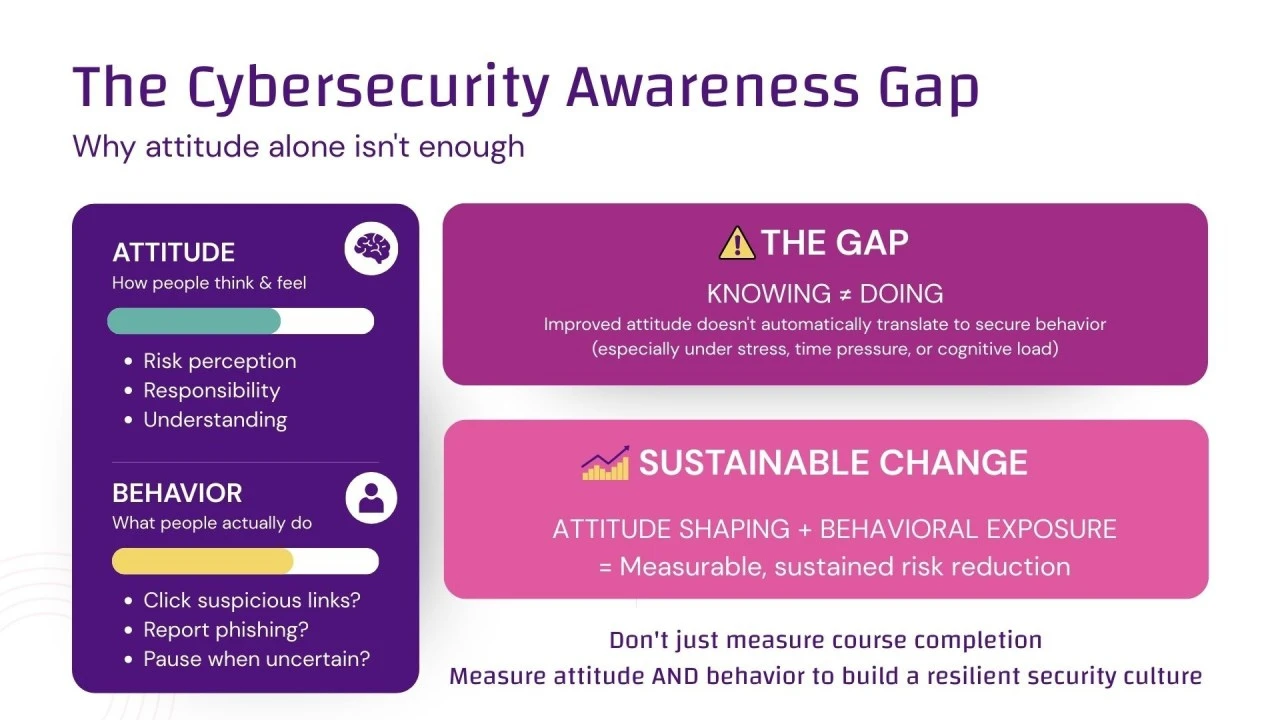
Attitude describes how people think and feel about a topic. In cybersecurity, this includes:
- How risky employees perceive phishing or social engineering to be
- Whether they feel personally responsible for security
- Whether they believe secure behavior is worth the effort
Attitude is shaped primarily through information, communication, and training. Traditional awareness programs focus heavily on this layer: policies, videos, e-learning, and explanations of “what could go wrong.”
Research confirms that training can indeed influence attitude. Employees often report higher awareness, stronger responsibility, and better understanding after training interventions.
What is (secure) behavior?
- Behavior is what people actually do in real situations:
- Do they click on a suspicious link?
- Do they report a phishing email?
- Do they pause when something feels off – or act on impulse?
Behavior is not measured by surveys or intentions. It is observable only through realistic situations and concrete actions.
This distinction matters. Multiple studies show that improved attitude does not automatically translate into secure behavior, especially under time pressure, stress, or cognitive load. The same studies show that secure behavior and cyber security attitude correlate (but its not a causality).
Why one without the other falls short
Why attitude alone is not enough
From psychology and behavioral science, we know the so-called attitude–behavior gap: people often act against their better knowledge. This is not irrational—it is human. Habits, heuristics, and situational cues dominate decision-making, particularly in fast-moving digital environments.
Recent cybersecurity research confirms this effect. Normative training improves how employees think about cyber risks, but has only a weak and inconsistent impact on how they act when confronted with real attacks .
Why behavior without attitude also fails
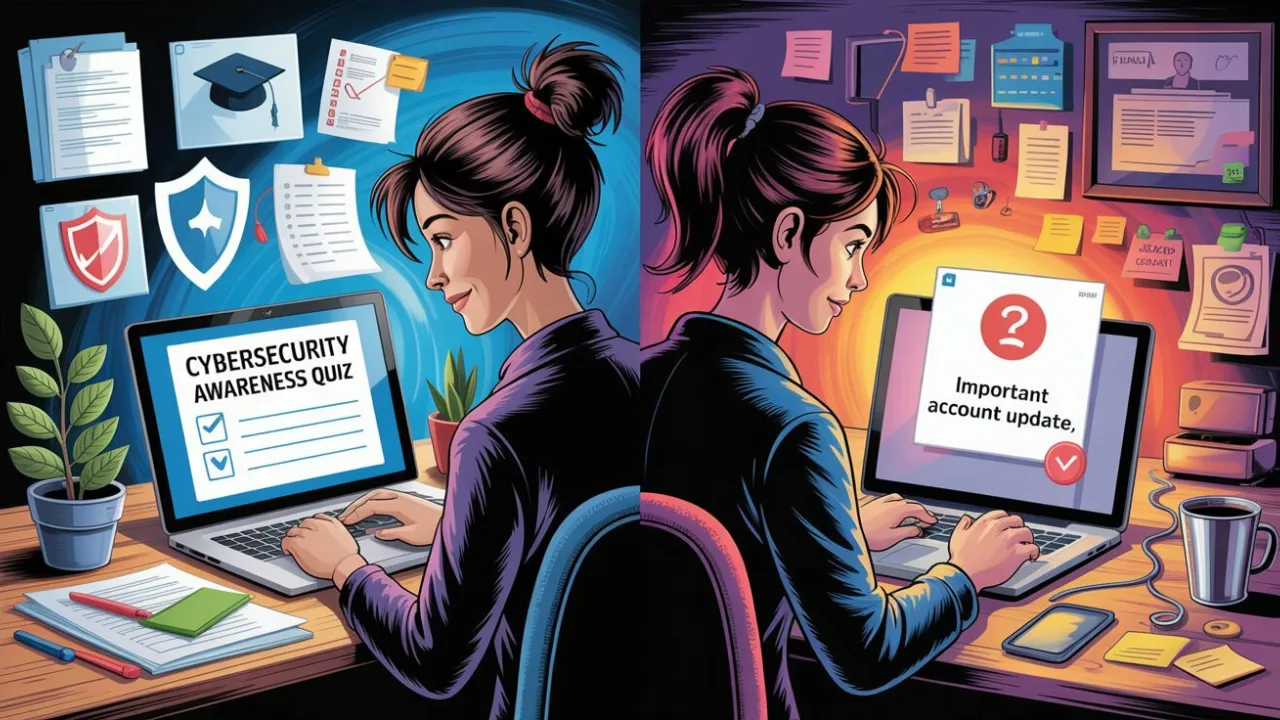
At the same time, behavior change without attitude change is fragile. Repeated drills without explanation can feel arbitrary or punitive. Employees may learn how to “pass the test” without understanding why it matters.
The result: short-term improvements that fade quickly once exercises stop—a pattern widely observed in awareness programs.
Sustainable change requires both
The evidence is clear: lasting behavioral change requires two complementary streams:
- Attitude shaping Training, communication, and explanation build risk perception, responsibility, and context.
- Behavioral exposure Realistic simulations and lived experience translate that mindset into action—especially when they reflect modern, AI-driven attack techniques.
CYBERDISE’s own AI-enabled spear phishing research shows this clearly. Training mainly affects attitude. Realistic, personalized attack simulations primarily affect behavior. Only the combination delivers measurable, sustained risk reduction .
Long story short: two distinct human risk factors
Attitude and behavior are distinct behavioral constructs, both human are risk factors, but they differ fundamentally in how they are formed, measured, and influenced
The takeaway for security leaders
This applies particularly to the DACH region: If your awareness program measures success only by course completion or quiz scores, you are measuring attitude, not risk. If it relies only on simulations without learning context, improvements will not last.
Effective cybersecurity awareness treats attitude and behavior as distinct, necessary, and complementary. Aligning both is not a nice-to-have. It is the foundation of a resilient security culture.
Sources
- Towards Diagnosing and Mitigating Behavioral Cyber Risks, Pugnetti et al., 2024 https://cdn.sanity.io/files/d9ejloir/production/1b157aa9316752311057159b59c4092afcabeda8.pdf
- Improving Cyber Risk Behavior through AI-Enabled Spearphishing, Pugnetti & Stacho, 2025 https://cdn.sanity.io/files/d9ejloir/production/de871aec8473a6722789e45edb9c347af9098b93.pdf